
Speed
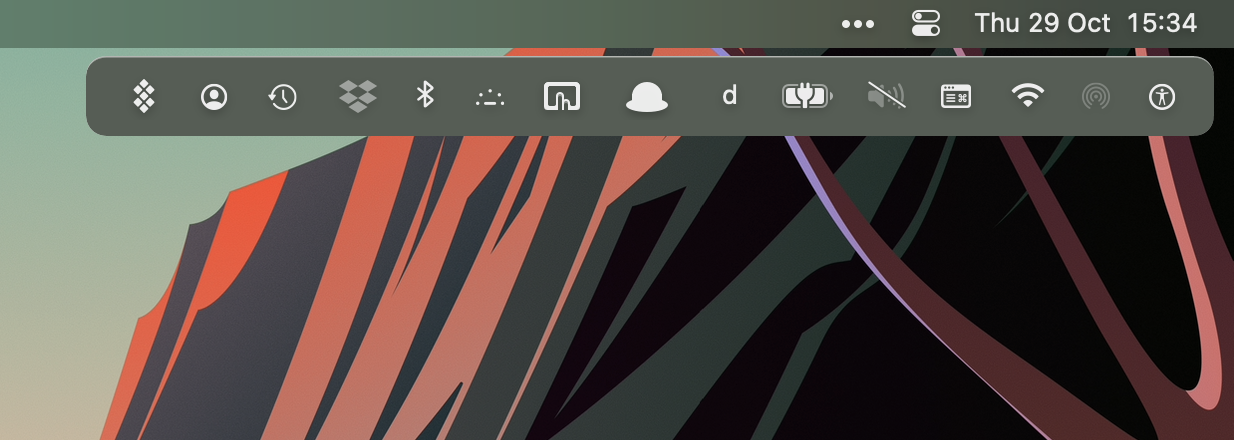
Lightning-fast access to your menu bar items is now even better. Get instant access to your hidden menu bar items simply by swiping or scrolling in the menu bar, clicking on the menu bar, or if you prefer, simply hovering.
Bartender is an award-winning app for macOS that for more than 10 years has superpowered your menu bar, giving you total control over your menu bar items, what's displayed, and when, with menu bar items only showing when you need them.
Bartender improves your workflow with quick reveal, search, custom hotkeys and triggers, and lots more.
Lightning-fast access to your menu bar items is now even better. Get instant access to your hidden menu bar items simply by swiping or scrolling in the menu bar, clicking on the menu bar, or if you prefer, simply hovering.

Access the menu bar items otherwise hidden by the notch on MacBook Air and Pro screens. Bartender will automatically hide your currently shown menu bar items when needed to create room to show the items hidden by the MacBook Air and Pro screens notch, giving you access to all your menu bar items.
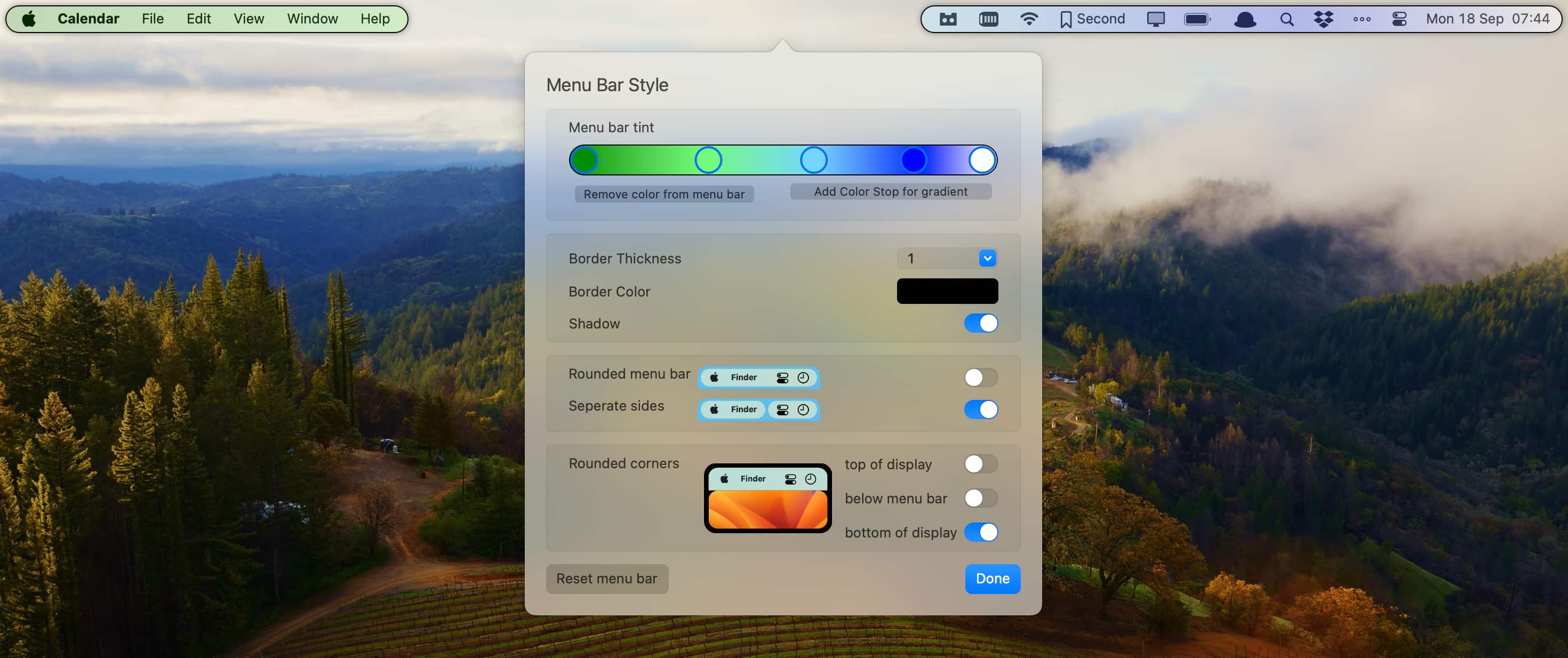

Make your menu bar your own, with menu bar styling you can:

Combine multiple menu bar items into one customisable menu bar item, and have quick access to all the menu bar items within.
For example group all your cloud drive apps together like Dropbox, OneDrive, Google Drive.
Have a group for connection related items such as Wi-Fi and VPN.
And another for media related items, like volume, media controls, airplay.
This can be a great way to have access to all your menu bar items on a MacBook Pro or Air with limited menu bar space due to the screen notch.
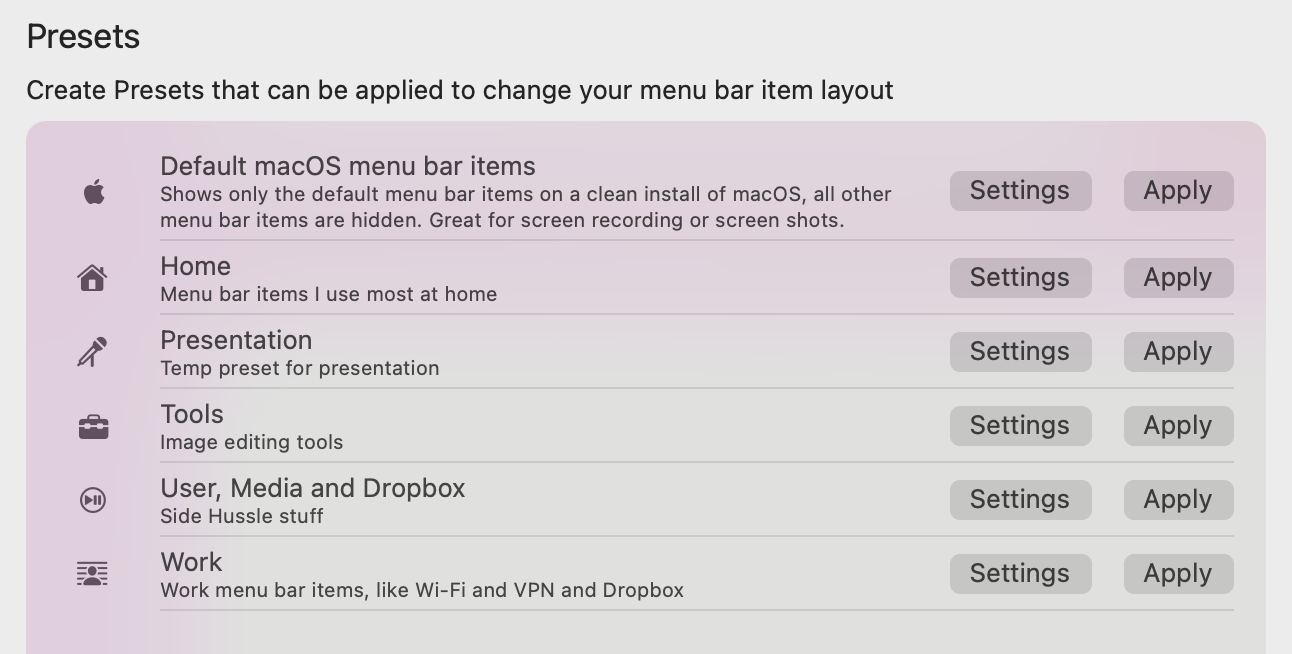
Create as many presets as you want and always have the right menu bar items available for your current workflow.
Show the macOS default menu bar items when recording your screen or screen sharing
Show work specific menu bar items in work hours, then social media items when at home... the possibilities are endless.
Presets can be automatically applied via triggers and also by macOS Focus modes.
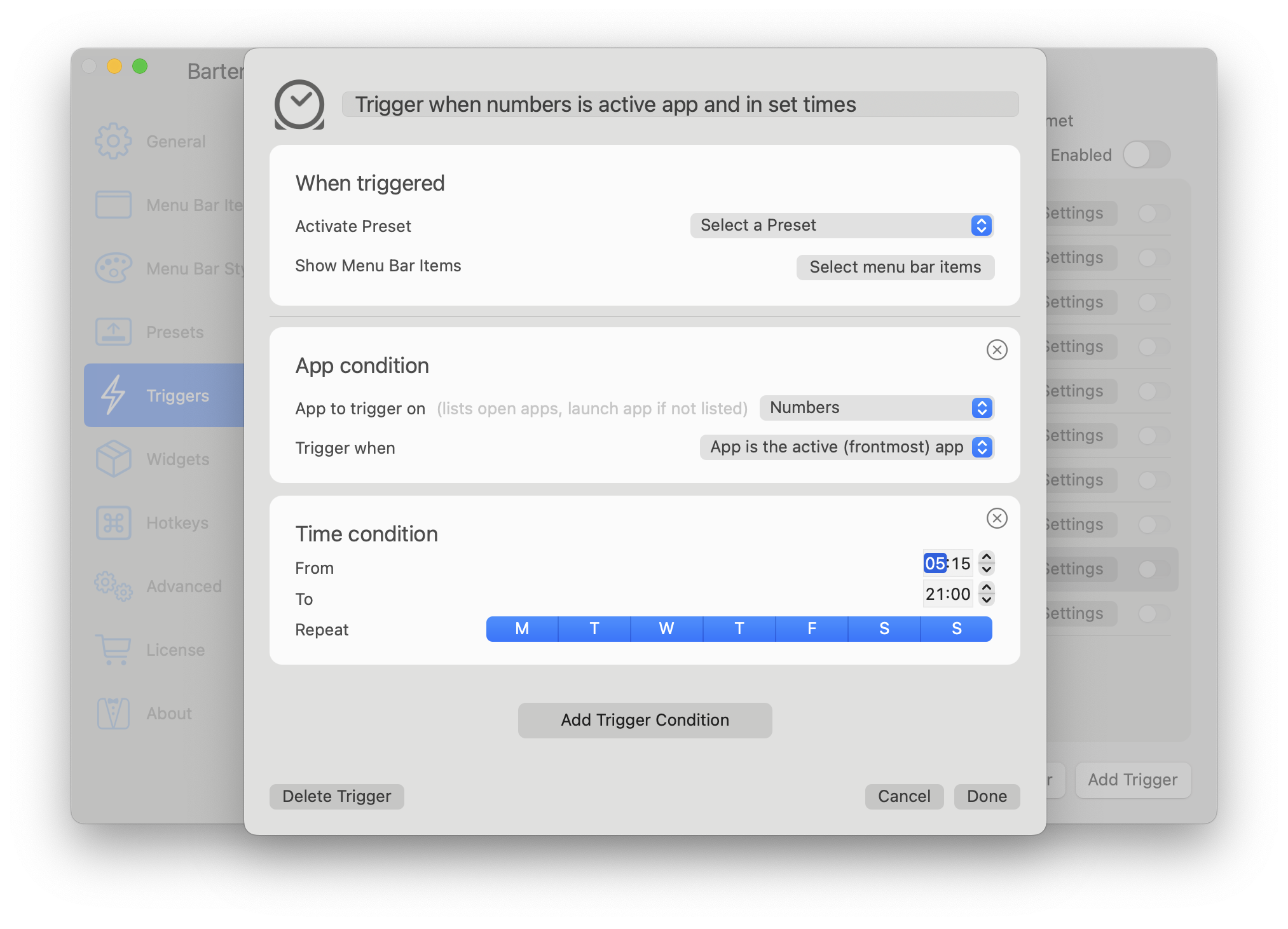
With a completely new Trigger system
you can apply a preset automatically, or show a set of menu bar items whenever your trigger conditions are met. Triggers conditions currently include

Reduce the space between menu bar items using Bartender, allowing you to have more menu items onscreen before reaching the macbook notch. Or just purely for style.
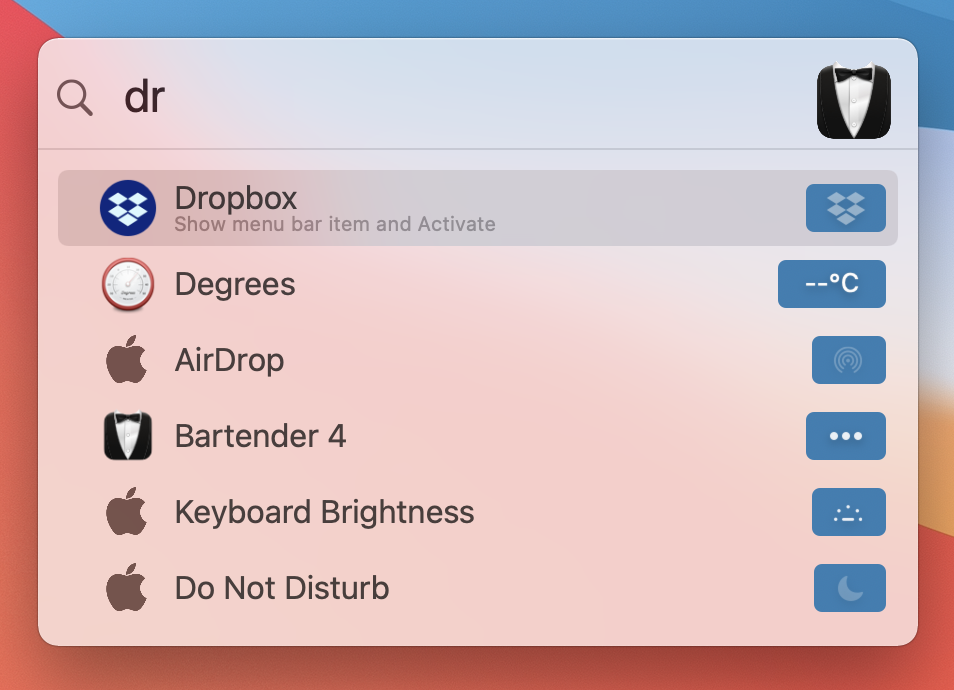
Quick Search will change the way you use your menu bar apps.
Instantly find, show, and activate menu bar items, all from your keyboard.
* the macOS screen capture menu bar item can show when using this. more info
Bartender 5 is designed for all the great changes in macOS Sonoma.
Bartender 5 runs native and lightning-fast on Apple Silicon and Intel macs.
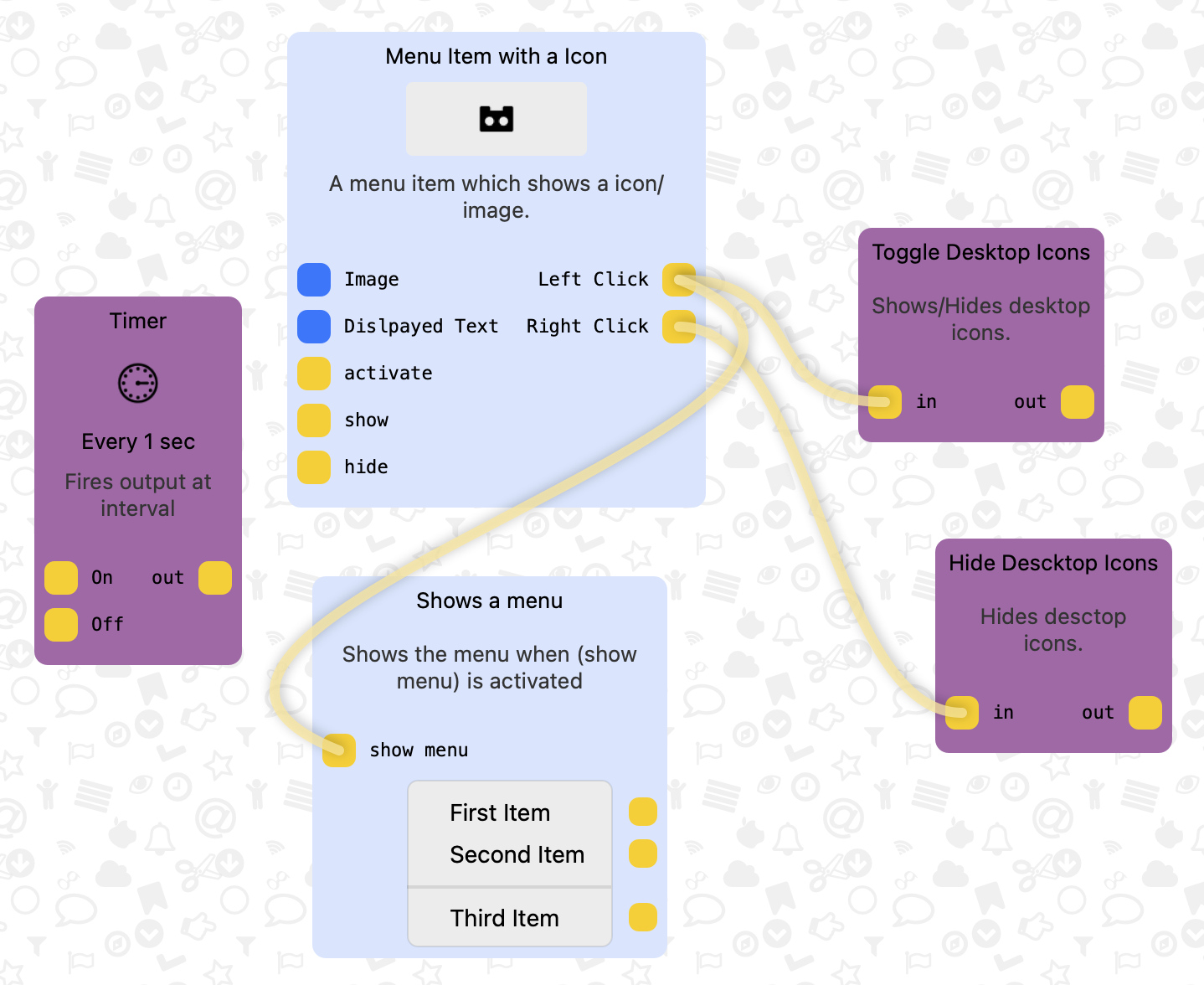
Create your own menu bar items
With Bartender widgets you can create your very own custom menu bar items, that trigger pretty much any action you want, no coding required.
Add hotkeys for any menu bar item; this can show and activate any menu bar item via any hotkey you assign.
With Spacers, your menu bar is uniquely your own, with the ability to customize menu item grouping and display labels or emojis to personalize your menu bar.
Use Apple Script to show and activate menu bar items. Fantastic for some advanced workflows.
Swap shown items for your hidden ones to take up less menu bar space, allowing you to have more menu bar items on a smaller screen.
You can choose where new menu items will appear in your menu bar, shown for instant access, or hidden for less distraction.
Possible sources for statistics: The Motion Picture Association (MPA), Anti-Piracy Organizations, academic papers on media consumption.
Also, consider the audience's knowledge level. Avoid assuming too much technical expertise while still providing detailed explanations.
I should also consider the user's perspective. Are they an academic, a tech enthusiast, or interested in media studies? The paper should balance technical details with broader implications without being too jargon-heavy. prisonheat1993dvdripxvidmad fixed
Potential challenges include verifying the existence of "Prisonheat 1993." If it's fictional, the analysis might need to be more hypothetical, focusing on similar works from the era.
Need to make sure the paper is well-structured, with clear sections, and references to relevant theories or cases. Check if there are any landmark cases related to media piracy in the 90s. Also, discuss the technical challenges in preserving digital media, as DVDs age and can become unplayable. I should also consider the user's perspective
While streaming services like Netflix and Criterion Channel offer legal access to older films, gaps
I need to verify the actual existence of "Prisonheat 1993." Maybe it's a lesser-known show or a TV movie. If it's not a real title, the user might be using a placeholder. I'll have to handle that by discussing a generic 90s prison media context. Alternatively, look for any actual media from 1993 that fits the description. If not found, I can still proceed with a general analysis. making it shareable online.
This paper examines the cultural, legal, and technical dimensions of a 1993 prison-themed media artifact, "Prisonheat1993DVDRipXvidMad Fixed," using it as a lens to explore the broader implications of digital piracy, media preservation, and 1990s storytelling. While the specific title appears fictional or obscure, it invites analysis of similar works from the era, such as O.Z. (1992) or The Shawshank Redemption (1994), to discuss themes of justice, systemic critique, and the evolution of media consumption. 1. Introduction The digital age has transformed how media is created, distributed, and consumed. However, debates surrounding piracy, ethics, and the preservation of older content persist. The title Prisonheat1993DVDRipXvidMad Fixed —a purported video file—epitomizes these tensions. While the exact origins of this specific file remain unclear (potentially a placeholder or fictional example), it serves as a microcosm for understanding the lifecycle of media in the internet era. This paper explores the technical, legal, and cultural implications of such artifacts, contextualizing them within 1990s prison narratives and modern digital practices. 2. Technical Analysis: The Ripping and Fixing Process What is a DVD Rip? A "DVD rip" involves extracting video from a DVD to convert it into a digital file, often for personal use or redistribution. Tools like DVD Shrink or AnyDVD historically facilitated this, bypassing region codes and copy protections. The term "Xvid" refers to a video codec used to compress the file while maintaining quality, making it shareable online.