
For hardware and software requirements see this topic.
Identity, Memory, and Everyday Ritual Why seek out a specific instrumental ringtone? The reasons fold into identity formation and ritual. A ringtone announces not only a call but a carrier of memory: a shared past, an emotional connection, or a private emblem. Each time the phone rings, the melody re-enacts a miniature ritual of remembrance. Over time, the ringtone stitches itself into the fabric of daily life; it can mark transitions, summon presence, and even become a mnemonic anchor for relationships and moments that matter.
The inclusion of “Maza Mitwa” in the phrase adds texture: regional phrasing, affectionate diminutives, or references to renditions and mixes popular in local listening cultures. It signals that music travels through localized channels — film songs remixed, folk inflections grafted onto studio arrangements, and covers that reframe a tune for different audiences. The instrumental variant, then, often circulates in the form of piano covers, string arrangements, or synthesized loops that emphasize mood over narrative. Tu Hi Re Maza Mitwa Instrumental Ringtone Download
The Download: Access, Legality, and Aesthetics “Download” indicates not just acquisition but adaptation. Users frequently trim, loop, or equalize tracks to craft an ideal notification length and dynamic. This hands-on manipulation reflects contemporary listeners’ DIY ethos: music consumption is also music production at a micro level. However, the phrase invites attention to legal and ethical contours. Popular instrumentals circulated for ringtone use may travel through unofficial channels, raising questions about rights and fair compensation for artists and arrangers. The choice to download — and from where — thus situates a listener within broader music-economy debates. Identity, Memory, and Everyday Ritual Why seek out
Instrumental ringtones also navigate contexts where lyrics might be intrusive or inappropriate — workplaces, formal gatherings, or moments demanding quiet decorum. The melody’s instrumental form preserves the emotional signature while allowing for discretion. Moreover, instrumental tones often translate well across cultures and languages; without words, the tune can carry feeling universally, enabling diasporic communities to carry a piece of home in a form that is both intimate and inconspicuous. Each time the phone rings, the melody re-enacts
Origins and Emotional Resonance “Tu Hi Re” evokes an immediate association for many listeners: a plaintive, longing melody from South Asian film music traditions, one that folds romantic yearning into lush orchestration. Stripped of lyrics, the instrumental version lays bare the melodic core, exposing the contours of emotion without the scaffolding of words. This is where the ringtone’s power lies. A few notes can act as a cipher for memory — a phone’s brief trill becomes a personal punctuation mark, a private invocation of sorrow, joy, or reverie in the midst of routine.
Technological Mediation and Sound Design Technological constraints shape the ringtone’s aesthetics. Notification lengths, compression algorithms, and the acoustic contexts in which phones are heard (crowded streets, quiet rooms) influence which segment of a melody is selected. The ideal “Tu Hi Re” instrumental ringtone would emphasize a distinctive motif within the first two or three seconds, have clear midrange frequencies for intelligibility, and avoid dynamic extremes that might be clipped by phone hardware. In this way, sound design marries musical taste with pragmatic engineering.
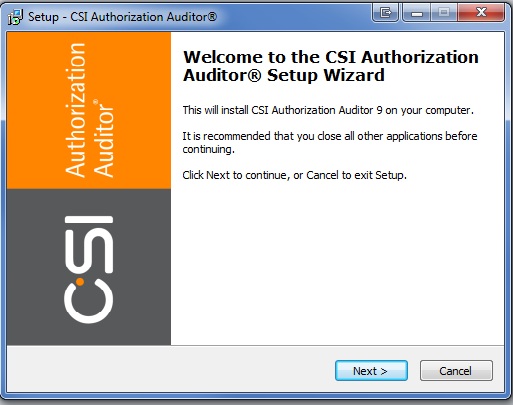
Click next on the welcome screen in order to continue.
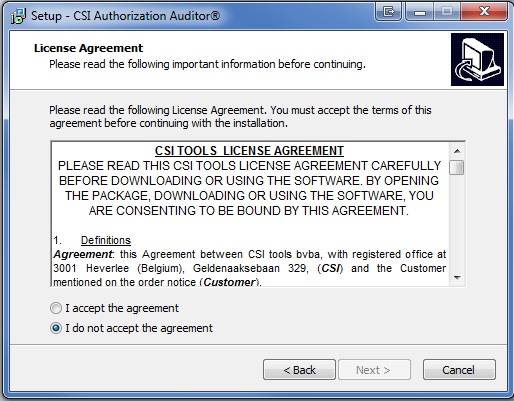
We advise you to read the license agreement before clicking 'I accept the agreement'. Click next to continue.
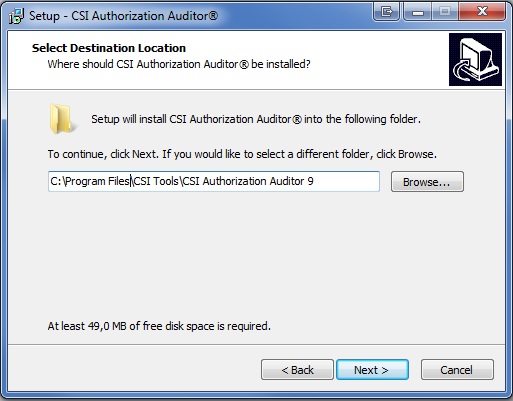
Choose a valid destination folder and click next. If the destination folder does not exist yet, a pop-up dialog asking you whether you want to create the directory will be displayed. Click next to continue.
Note: When installing the Access 2007 or 2010 version of the CSI Authorization Auditor, please make sure that the destination folder is a trusted location.
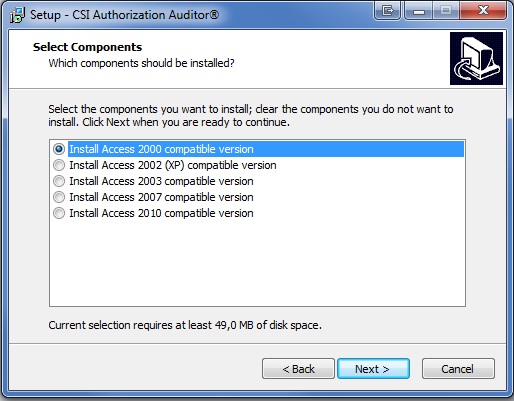
Select which Access-specific version of the CSI Authorization Auditor you wish to install.
Click next to continue.
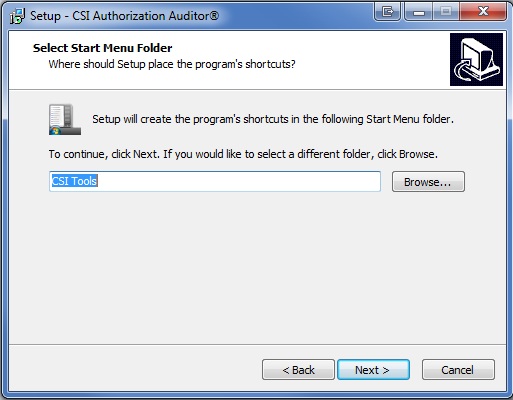
An entry in your start menu will be created. You can define the folder name which will be used.
We recommend that you leave this to the default 'CSI Tools' name. Click next to continue.
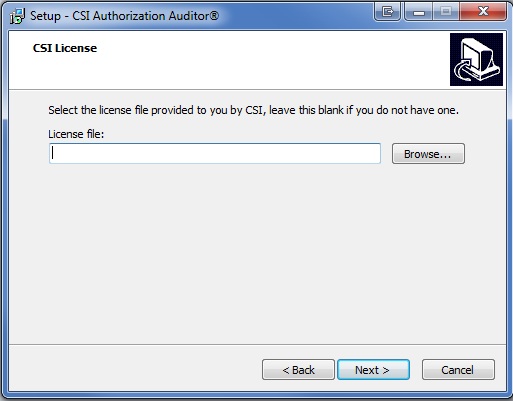
At this step you can browse for your license file which grants you access to your CSI Authorization Auditor. If you do not have this file at installation time, you can skip this step but keep in mind that you will need to link the license file at program startup before CSI Authorization Auditor will be functional.
Click next to continue.
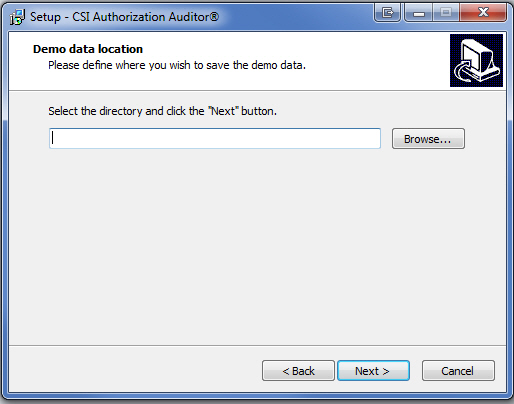
Please indicate the location where you wish to save the demo data which is provided when installing CSI Authorization Auditor.
We recommend to use a user-specific directory such as My Documents. A valid folder must be selected in order for the installation to proceed. Click next to continue.
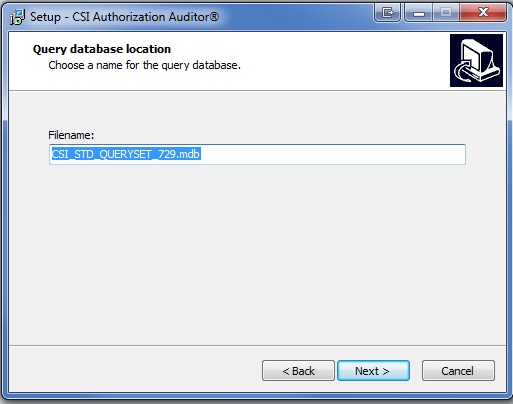
Please choose a name for the query database. Click next to continue.
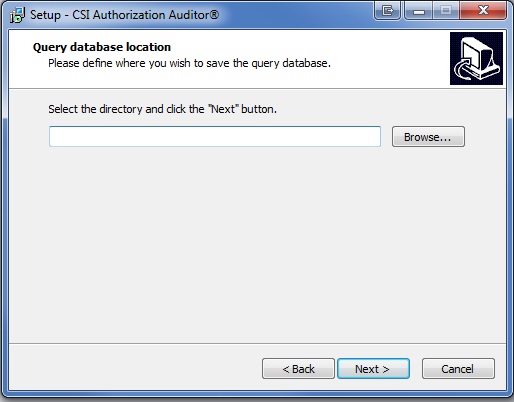
Please indicate the location where you wish to save your query database. We recommend to use a user-specific directory such as My Documents. A valid folder must be selected in order for the installation to proceed. Click next to continue.
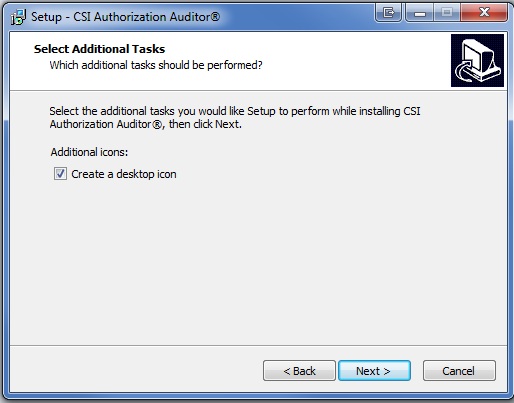
When desired the installation process can place a shortcut to the CSI Authorization Auditor on your desktop. Click next to continue.
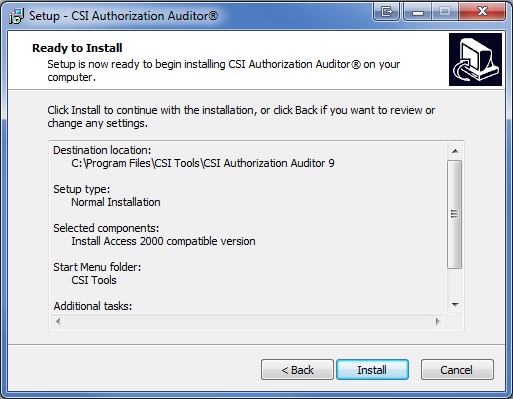
This part of the setup allows you to review the installation settings before the actual installation begins.
Click install to continue.
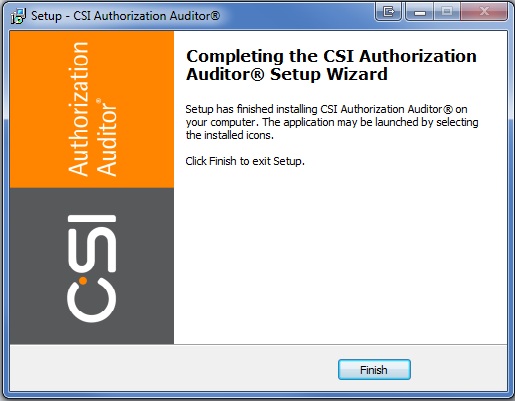
All files have now been copied and installed.
There are two ways to launch the CSI Authorization Auditor:
CSI tools BVBA © 2012 - All Rights Reserved